Challenge Six: Expressing More Gratitude,
Appreciation, Encouragement, & Delight
“Radiating The Four Heart Beams”
A From-To / Many-View Prologue
- From noticing only what’s broken… to seeing what is wonderfully together
- From the necessary attention to problems… to the transformative attention to gifts
- From taking the air, the water, the sunlight for granted… to receiving them with wonder and delight
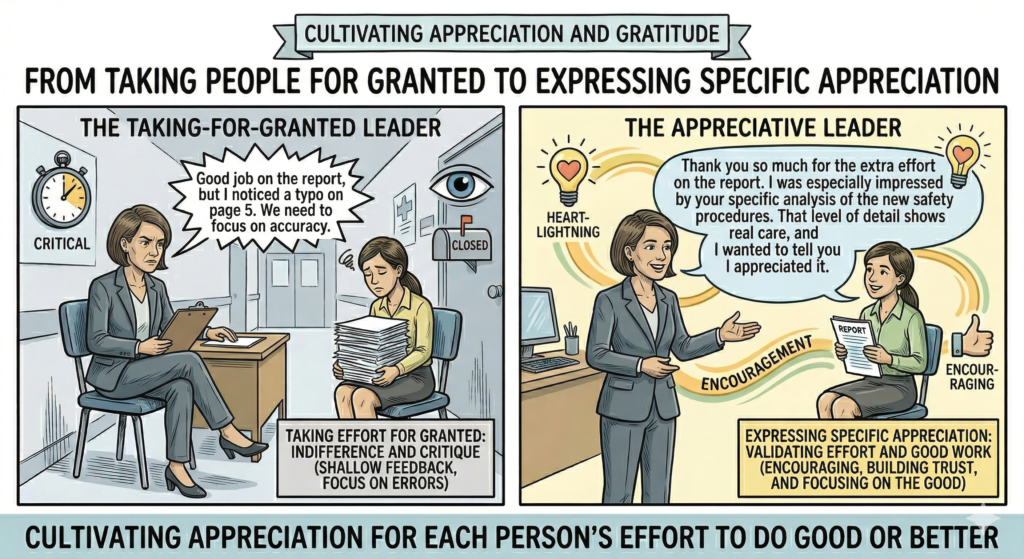
- From the silent expectation that people should perform their jobs well… to the voiced recognition and acknowledgment when they do
- From gratitude as a private feeling… to appreciation as a communal act of witness
- From the fear that joy will be taken away… to the courage of letting yourself feel it
- From encouragement as cheerleading… to encouragement as seeing someone’s becoming
- From “you’re great”… to “when you did that, here’s how it met my needs”
- From the exhaustion of a life defined by what’s wrong… to the replenishment of a life that also sees what’s right
- From isolated self-improvement… to the shared practice of noticing grace — together
Challenge Six Summary
In order to build more satisfying relationships with the people around you, and to live a richer life yourself, develop the practice of expressing more of what I call the four heart beams: gratitude, appreciation, encouragement, and delight.
Because life continually requires us to attend to problems and breakdowns, it is very easy to see in life only what is broken and needs fixing. But satisfying relationships — and a happy life — require us to notice and respond to what is delightful, excellent, kind, skillful, and generous: to work well done, to food well cooked, to kindness extended to strangers, to beauty encountered along the way.

Hand Over Heart — Universal Gesture of Gratitude
Public Domain Image — AI + Dennis Rivers
This chapter explores both the deep reasons why appreciation and gratitude matter so profoundly (Part One) and the practical skills for expressing them in ways that strengthen your relationships and nourish your own heart (Part Two). At the heart of this exploration is a question worth sitting with: Why do human beings systematically starve themselves of the very nourishment that makes relationships and life itself bearable — and how can we come to understand our internal barriers toward gratitude, and learn to overcome them?
It is appreciation and gratitude that make a relationship strong enough to accommodate differences and bounce back from disagreements. And it is the practice of noticing grace — in all its forms — that keeps us from being swallowed up by the necessarily narrow focus of problem-solving.
PART ONE: EXPLORING THE ATTITUDE
OF THE GRATEFUL HEART
Sections 6.1 through 6.7
6.1 The Blind Spot at the Center
of Human Attention
There is something built into the structure of human awareness that makes gratitude difficult — and that difficulty is worth understanding before we try to practice our way past it.
Think about the last time you walked into your home. Did you notice the roof keeping rain off your head? The floor holding you up? The light switch that worked when you flipped it? Almost certainly not. And that’s not because you’re ungrateful. It’s because human consciousness is designed to notice what’s broken, what’s threatening, what needs fixing. The things that are working — the air in your lungs right now, the friend who has been faithful for twenty years, the colleague who quietly does excellent work — become invisible precisely because they’re functioning.
The philosopher Martin Heidegger thought about this at length. He observed that our tools and our world disappear from our awareness when they are working smoothly. We notice the hammer only when it breaks. We notice our health only when we lose it. We notice a relationship only when it’s in crisis. This isn’t a character flaw. It’s a structural feature of how attention works. It served our ancestors well — the early human who noticed the rustling in the grass survived; the one who was busy admiring the sunset did not.
But here’s the cost. If our attention is perpetually drawn toward breakdown — toward what’s wrong, what’s missing, what needs repair — then we are at risk of becoming profoundly out of touch with what you might call the thousand forms of grace that support everyday life. We are beneficiaries of a universe infinitely larger than our own making: air, water, sunlight, the web of life, the accumulated gifts of human culture, the daily kindnesses of people around us. None of this is of our own doing. All of it sustains us. And our built-in bias toward breakdown means that, without deliberate practice, we may sleepwalk through the very gifts that make our lives possible.
That is why gratitude and appreciation are not luxuries. They are not the cherry on top of a good life. They are correctives to a profound structural bias in human attention — a bias that, left unchecked, can leave us feeling impoverished in the midst of abundance, lonely in the midst of love, and exhausted by a world that seems to offer nothing but problems.
Expressing more appreciation is probably the most powerful and rewarding of the Challenges described in this workbook. It is also one of the most demanding. Not because it requires great skill — the skill, as you’ll see in Part Two, is surprisingly straightforward — but because it requires a shift in the very direction of your attention. You are asking your consciousness to do something it was not designed to do automatically: to turn toward what is working, what is beautiful, what is kind, and to linger there long enough to feel it and say so.
If this bias is truly structural — wired into the very architecture of human attention — then a natural question arises: Does correcting it actually make a measurable difference? Or is this just a beautiful philosophical observation with no practical consequence?
The answer, as it turns out, is among the most dramatic findings in the social sciences.
6.2 The Research: What Happens When Appreciation Is Present and When It Isn’t
Couples. If, like me, you have not given much attention to the topic of appreciation, you will probably be as amazed as I was to learn the results of recent research. What researcher John Gottman and others have found is that the determining factor in the long-term success of love relationships — and, I strongly suspect, friendships and work relationships as well — is the ratio of appreciations to criticisms. The magic ratio appears to be approximately five expressions of appreciation for every one expression of criticism or displeasure. Couples who fell below this ratio were significantly more likely to divorce. Couples who maintained it were significantly more likely to stay together — and to be happy together.
This is a staggering finding. It means that the emotional atmosphere of a relationship is not determined primarily by how well you handle conflict (though that matters). It is determined by how much positive recognition flows between the two people on an ordinary day. The five-to-one ratio is not about grand romantic gestures. It’s about the small, daily acts of noticing and naming what your partner does well, what you enjoy about them, what you’re grateful for. It’s about counteracting the breakdown bias, one small expression at a time. Bringing up children. The child development research of Betty Hart and Todd Risley produced a strikingly parallel conclusion regarding parent-child interaction. They found that children who are the most curious, creative, self-starting, and enthusiastic about learning come from homes where approvals and expressions of interest in what the child is doing exceed prohibitions and corrections by a ratio of about three to one. (The emphasis here is on expressions of interest as much as overt approval — simply paying positive attention to what a child is doing communicates volumes.)
The most important implication of the Hart and Risley research for this workbook is that appreciation nurtures. Self-esteem in both children and adults contains a large component of internalized appreciation received from others. Just as we know intuitively that plants need sunshine in order to grow, their results show us in concrete terms how much people need positive recognition. Appreciation is the sunshine of both human interaction and human development.
Creating successful organizations. In his book for managers, Bringing Out the Best in People, management consultant Aubrey Daniels argues that recognition and appreciation are the most powerful motivators available to managers and leaders — more powerful than money, status, or fear. And yet most organizations operate on the assumption that people should simply do their jobs without being thanked. The result is a chronic appreciation deficit that drains morale, reduces initiative, and drives away the very people every organization most needs to keep.
Living more gratefully. In his book Gratefulness, the Heart of Prayer, Brother David Steindl-Rast suggests that spiritual life makes much more sense if we see all spiritual virtues as radiating out from one central experience: gratefulness. Faith, hope, love, compassion — each of these, he argues, is a particular expression of an underlying gratefulness toward life itself. This is not a sentimental claim. It is a radical reorientation: what if the deepest spiritual practice is simply to pay attention to what we have been given?
The evidence, then, is not ambiguous. Across marriages, families, workplaces, and spiritual traditions, the same finding appears: when positive recognition is present in sufficient measure, human beings flourish. When it is absent, they wither — slowly, invisibly, and often without understanding why.
And yet. If the evidence is this clear — if the five-to-one ratio is as robust as Gottman found it to be — then why aren’t we all swimming in expressions of gratitude? The breakdown bias described in the previous section explains why we fail to notice what is good. But surely something more than forgetfulness is at work. There is another obstacle, deeper and more personal, that explains why we sometimes refuse to feel gratitude — even when we notice it perfectly well.
6.3 The Vulnerability of Joy
The researcher Brené Brown, in her book The Gifts of Imperfection, describes a phenomenon she calls foreboding joy — the experience of feeling a rush of happiness and then immediately bracing for disaster. You watch your child sleeping peacefully and your mind floods with images of everything that could go wrong. You receive good news and think, “This can’t last.” You feel a swell of love for your partner and your next thought is about loss.
Brown’s research reveals that many of us unconsciously believe that if we let ourselves feel too much joy, we are making ourselves vulnerable to a greater fall. We rehearse disaster as a way of protecting ourselves from the pain of losing what we love. And the result is that we numb ourselves to the very experiences that would nourish us most.
This has profound implications for the practice of gratitude. To feel genuinely grateful — not just to say the words, but to let the feeling land — is to acknowledge that something good has happened and that it could be taken away. Every expression of gratitude is, at some level, an act of courage: the courage to say “this matters to me” in a world where what matters to us can be lost.
Brown found that the antidote to foreboding joy is not steeling yourself against loss. It is the practice of gratitude itself. The people in her research who were most resilient in the face of difficulty were not the ones who had learned to suppress their joy. They were the ones who had learned to pause in moments of happiness and deliberately feel thankful. The practice of gratitude, it turns out, doesn’t make you more vulnerable. It makes you more able to bear what comes.
If you recognize yourself in this description — if you find it difficult to let yourself simply enjoy a good moment without immediately worrying about what might follow — know that you are not alone, and that the practice of gratitude described in this chapter is, among other things, a gentle way of learning to let joy in without running from it.
So the breakdown bias pulls our attention toward what is wrong, and our emotional armor defends us against feeling what is right. But is there something even deeper at work? Is there a layer beneath both attention and emotion — a layer where the very stories we tell about our lives keep the barriers to gratitude firmly in place?
6.4 Stories, Suffering, and the Themes We Live By
When bad things happen — and they will — we are often left feeling bewildered. A marriage falls apart. A job disappears. Someone we trusted betrays us. The sheer chaos of painful experience can feel unbearable, and so we do what human beings have always done: we reach for an explanation. We try to make sense of the pain by telling ourselves a story about what it means and why it happened.
The psychologist Martin Seligman spent decades studying exactly this process — the way human beings explain bad events to themselves — and what he discovered can change a life. Seligman found that when something goes wrong, we tend to answer three questions about it, usually without even realizing we are doing so. The first question is about permanence: “Is this going to last forever?” When we are in pain, it is natural to feel as though the pain will never end. “I’ll always be alone.” “Things will never get better.” But notice that the same event can be explained very differently: “This is a terrible season, and seasons change.”
The second question is about pervasiveness: “Does this ruin everything?” A setback in one area of life can feel as though it has contaminated all the others. The person who loses a job may begin to feel like a failure as a parent, as a friend, as a human being. But a job loss, however painful, is not proof that all of life has gone dark.
The third question is about personalization: “Is this my fault — is something fundamentally wrong with me?” This may be the most painful move of all, because it turns a bad event into evidence of a bad self. “I didn’t just have a relationship that didn’t work out — I am an unlovable person.”
Seligman called these three dimensions our explanatory style, and he noticed that people who habitually explain bad events as permanent, pervasive, and personal tend to fall into what he called learned helplessness — a state in which a person stops trying, not because they are lazy or weak, but because their own explanation of events has convinced them that trying won’t help.
I want to pause here and say something personal. If you recognize yourself in that description, please be gentle with yourself. Learned helplessness is not a character flaw. It is a deeply human response to pain. The stories we told ourselves in difficult times were the best sense we could make with what we had. They were survival strategies, and they deserve our recognition for getting us through.
But Seligman also discovered something full of hope. He found that explanatory style is not fixed. It can be gently, patiently shifted — not by pretending that bad things didn’t happen, but by questioning the scope of our conclusions. He called this process learned optimism, and it does not mean putting on a happy face. It means learning to ask ourselves better questions.
When we catch ourselves thinking, “Nothing ever works out for me,” we can pause and ask: Is that really true? Has nothing ever worked out? Or have some things worked out, and one important thing has just gone very badly? When we catch ourselves thinking, “I’m just not good enough,” we can pause and ask: Not good enough for what? According to whom? And is that judgment permanent, or is it a snapshot of one painful moment?
This is not simply about replacing a gloomy story with a cheerful one. It is about noticing that the gloomy story, for all its emotional power, leaves out an enormous amount of evidence. A person who has experienced deep betrayal may carry the theme that people are not trustworthy — and yet that same person is almost certainly surrounded by many people who behave in very trustworthy ways. Think of all the millions of drivers around the world who faithfully stop at every red light, allowing us to safely pass. The theme of universal untrustworthiness, however real it might feel at a moment of great disappointment, does not account for all those people.
There can be a freeing humility in acknowledging that life is so vast, so infinitely varied, that all of our sweeping generalizations about it must necessarily be incomplete. Zen teachers call this “beginner’s mind”: the deep acknowledgment that we never see the whole picture, and that each moment has the potential to surprise us. Coming into the present and paying grateful attention to each flower we pass is a way of saying, “My life is more than what happened yesterday.”
Seligman’s research gives us scientific grounds for what the Zen teachers intuited: our explanatory stories are partial. They select certain events and ignore others. They are maps, not the territories themselves. And like all maps, they can be redrawn to include previously excluded features of the terrain.
So the practice I am inviting you into here is not about simply throwing your old themes away. It is about both seeing them consciously, and about seeing beyond them. With great inner kindness, you might begin to recognize the themes that have helped you make sense of life up to now — they were the best you could do at that moment. But this is a new moment.
Suffering is real and must be honored. And… we bring a certain set of skills and practiced responses to our suffering. Those skills and practiced responses can change. The experience of pain shrinks our field of attention; the practice of gratitude expands it.
We have now looked at three layers of what makes gratitude difficult. The first is structural: human attention is wired for breakdown. The second is emotional: even when we notice something good, we may armor ourselves against the vulnerability of enjoying it. The third is narrative: the stories we have built to survive our pain may have become so all-encompassing that they filter out the evidence of grace.
None of these obstacles is a character flaw. Each was, in its season, a strategy for getting through. But here is the good news hidden inside this excavation: if the obstacles to gratitude are learned — learned attention patterns, learned emotional defenses, learned narrative themes — then they can also be gently unlearned and replaced. Not by force, not by pretending that suffering isn’t real, but by the simplest possible practice: beginning to say yes.
6.5 Receiving Each Day as a Gift
Brother David Steindl-Rast’s invitation, in his book Gratefulness, the Heart of Prayer, to “receive each day as a gift” is not a demand that we ignore suffering or pretend that life is easier than it is. It is a practice of attention — a deliberate widening of the lens to include what the breakdown bias would otherwise hide. One possible first step is to think of any days in your life that have felt like gifts or blessings. This can be even more helpful if you write about them. Your Learning Journal can hold these sparkling moments in a way that allows you to return to them again and again, in a way similar to the way many native tribes carry in a little pot some burning embers from their last campfire, to help them start their next campfire in a new place.
After reading Brother David’s book I had a kind of aha! moment. Our capacities to see underlying patterns and make generalizations are some of our most powerful mental tools. And, like all of our physically powerful tools: drills, saws, etc., they need to be used consciously and managed carefully. Mental tools bring special risks. As a user of physical tools, we are not likely to imagine that we can do every possible task with the very same wrench. But as a user of mental tools, we can become enchanted with one or another of them, like the capacity to generalize, and imagine that tool is what every moment needs. Brother David calls us back from the edge of that narrow rut, and invites us to look up and embrace the gifts that come with each day: sunlight, friendships, air, food, the squirrels in the tree down the street — gifts wonderfully larger, more varied, and more alive, than even our best generalizations.
Saying thank you as a way of saying yes to life. Another possible step in cultivating a grateful heart is to look for small ways to say thank you to total strangers. When you are in a restaurant and the server pours you a glass of water, say thank you. When someone holds the door, say thank you. When the bus driver drops you at your stop, say thank you. These are tiny acts, but they are not trivial. Each one is a small “yes” to the web of cooperation that makes daily life possible.
Behind this practice is a recognition that, for many of us, our long engagement with the problems of the world — political, ecological, personal — has required us to say “no” a great deal, and to say “no” very consistently for years on end. It seems to me important to develop a counterbalancing practice of saying “yes” and “thank you.” The world’s problems need our “no.” But our hearts need our “yes” in order to stay engaged with life. And paradoxically, the problems of the world need our capacity to say “yes” also. As immortalized in John Lennon’s song, Imagine, the problems of the world call out to us to steadfastly imagine something better.
Expressing gratitude in the middle of a difficult life. Considered on a wider level, part of the problem of suffering and oppression is that people who are oppressed tend to become obsessed with the actions of their oppressors. While that is certainly understandable, it is also deeply sad and unfair, because it means that the oppressors fill up all the psychic space that might be available for beauty, connection, meaning, joy and new beginnings. Learning to also notice what is good, beautiful, and kind — even in the midst of difficulty — is not a betrayal of one’s struggle. It is a refusal to let the struggle consume everything. It is a life-affirming form of resistance to oppression past and present.
A dear friend of mine, bedridden for years with a debilitating disease, learned to find sustaining comfort in the stars that shine through her windows at night. She became grateful for the garden outside her window, and for the birds that visited it. She did not pretend that her illness was a gift. But she refused to let it blind her to the gifts that remained. Her practice of noticing beauty in the midst of suffering was one of the most courageous things I have ever witnessed.
Ultimately, it is even possible to accept with a grateful heart a life that includes troubles. The difficulties of our lives, after all, challenge us to become deeper people, more aware and more compassionate. We would not grow without them, as the wise and kind author Judith Viorst observed in her book, Necessary Losses. This is not an easy practice or attitude to adopt, and in my view it should never be imposed on anyone from outside. (That will almost always backfire.) But for those who find their way to it, it can be profoundly liberating: a way of transforming even our suffering into a conscious doorway for growth.
These first steps — saying thank you to a stranger, writing down a blessing, letting a good moment simply be good without bracing for disaster — are the beginning of a practice. But as you try them, you may notice something: the word “gratitude” starts to feel too small for everything you’re experiencing. Thanking the server who pours your water feels different from the catch in your throat when you watch a stranger help someone in need. The quiet warmth of being cared for by a friend feels different from the fierce hope you feel when you see someone learning to do something difficult. Are these all “gratitude”? Or are they distinct experiences — each with its own inner posture and its own particular gift to give?
6.6 The Four Heart Beams: A Taxonomy of Noticing
I have spent many years using the phrase “gratitude, appreciation, encouragement, and delight,” knowing that they overlapped a lot. But it took a while for me to see that they were both connected and different, four distinct experiences and practices, each with its own inner posture and its own gift to offer. Understanding the differences can help you develop all four, rather than relying primarily on whichever one comes most naturally.
Gratitude is the warm recognition that someone has met a need of yours — and the impulse to let them know you felt it. Your neighbor brought soup when you were sick. Your partner listened when you needed to talk. Your colleague covered for you during a difficult week. Gratitude flows along the channel of your own experience: I received something good, and I want you to know. It is personal, specific, and relational. It strengthens the bond between giver and receiver. Appreciation is something larger. I feel gratitude toward someone who meets my particular need. But I feel appreciation toward someone who meets the needs of others — not necessarily mine at all. When I watch a stranger help an elderly person across a busy street, no need of mine has been met. When I learn about someone who spent years restoring a damaged wetland, I wasn’t personally affected by the damage or the restoration. And yet something in me responds — something that wants to say so.
That impulse to say so is worth examining. On whose behalf am I speaking? The answer, I believe, is: on behalf of the human community. On behalf of the web of life. Expressing appreciation for acts of goodness and kindness is a way of saying thank you on behalf of everyone who benefits — including people and creatures who may never know what was done for them.
Appreciation, understood this way, is an act of witness. It says: “I saw what you did. It mattered. Not just to me — to us. To the larger fabric of life that holds all of us.” And when you express appreciation publicly, you are inviting everyone within earshot to notice. You are expanding the community’s capacity to see grace.
Delight is the spontaneous overflow of joy in the presence of something beautiful, excellent, or alive. It is less about meeting needs and more about being moved. The first crocus of spring. A child’s unselfconscious laughter. A piece of music that makes you catch your breath. Delight asks nothing and explains nothing. It simply says: I am moved, and I want to share this aliveness with you. Delight is perhaps the most purely generous of the four heart beams, because it flows outward from joy itself, asking nothing in return.
Encouragement is forward-looking. Where gratitude and appreciation respond to what has already been done, and delight responds to what is, encouragement responds to what is becoming. It says: “I see you struggling toward something good, and I want to strengthen your resolve.” Encouragement is not cheerleading — not the empty “You can do it!” that costs the speaker nothing. Real encouragement requires that you actually see the person: where they are, what they’re reaching for, and what it’s costing them. It says: “I see the effort. I see the direction. I believe in what you’re becoming.”
Each of these four heart beams is a different corrective to the breakdown bias described in section 6.11. Gratitude corrects the tendency to take personal gifts for granted. Appreciation corrects the cultural blindness to acts of goodness that don’t involve us directly. Delight corrects the habit of rushing past beauty on the way to the next problem. And encouragement corrects the isolation of someone who is trying to grow but can’t yet see their own progress.
Together, they form a practice of attention that can gradually, gently shift the balance of your inner life from one dominated by what’s wrong to one that also — regularly, deliberately, joyfully — notices what’s right.
Up to this point, we have been exploring gratitude and its sister practices primarily in the space between human beings: gratitude toward a friend, appreciation of a colleague, delight shared with a loved one, encouragement offered to someone who is growing. But there is a tradition — much older than psychology, older than Western philosophy — that understands gratitude on a scale we have not yet considered. What happens when we extend the four heart beams not just toward the people in our lives, but toward the air, the water, the soil, the web of life that makes every human relationship possible?
6.7 Gratitude as Reciprocity:
The Ecological Vision
In her luminous book Braiding Sweetgrass, botanist and Potawatomi tribal member Robin Wall Kimmerer describes a way of understanding gratitude that goes far deeper than individual thankfulness. In the indigenous traditions she draws from, gratitude is not primarily a personal emotion. It is a practice of reciprocity — a way of staying in right relationship with the living world that sustains us.
The Thanksgiving Address of the Haudenosaunee Native American tribe, for example, is not a list of personal blessings. It is a communal ceremony in which the people collectively acknowledge the waters, the plants, the animals, the sun, the moon, the stars — one by one, with care and attention, on behalf of all of us. It is the community bearing witness to the gifts of the living world. It is, in the terms of this chapter, appreciation on the largest possible scale.
Kimmerer’s central insight is that we are not separate from the world that feeds us. We are in a relationship of mutual giving and receiving with the air, the water, the soil, the web of life. Gratitude, in this framing, is the practice of remembering that you are a recipient before you are an agent. You didn’t make the air. You didn’t make the water. You didn’t weave the web of photosynthesis that turns sunlight into the food on your table. To live without acknowledging these gifts is to live in a kind of amnesia — an amnesia that has ecological as well as spiritual consequences.
This ecological vision of gratitude deepens our understanding of what appreciation can mean. When we extend our practice of noticing beyond the human world — to the rain that fills our reservoirs, the bees that pollinate our food, the trees that clean our air — we begin to inhabit a universe that is not merely a collection of resources to be managed, but a web of gifts to be received with care and reciprocated with attention. That shift of perception is itself a form of ecological repair.
And so Part One of this chapter arrives at its widest horizon. We began by noticing a structural bias in human attention — the tendency to see only what is broken. We explored the research that shows how dramatically relationships and organizations suffer when that bias goes uncorrected. We sat with the emotional armor of foreboding joy and the narrative prison of learned helplessness — two deeply human barriers that keep us from receiving the nourishment of gratitude even when it is right in front of us. We took our first tentative steps toward practice: saying yes, writing down blessings, letting joy land. We discovered that what we had been calling “gratitude” is actually four distinct practices, each with its own gift. And now, through Kimmerer’s ecological vision, we see that the circle of attention we are learning to widen has no outer boundary — it extends to the living world itself.
All of this has been about why — why gratitude matters, what blocks it, and how wide its reach can be. Now we turn to how. What words, what structure, what practice makes an expression of gratitude land — not as flattery, not as vague warmth, but as genuine recognition that the other person feels in their bones?
PART TWO: HOW — THE PRACTICE OF EXPRESSING WHAT YOU SEE
6.8 The Inner Structure of Appreciation: Three-Part Messages
To express gratitude in a meaningful way, a person needs to actually feel grateful, and that often involves looking at a person or situation from a new angle. Expressing appreciation thus involves both opening the heart and engaging the mind. That is what Part One of this chapter has been about: the opening.
Now we turn to the practical craft of saying what you see. And here, the work we did in Challenge Three on the Five I-Messages gives us a powerful framework.
In Challenge Three, we explored the Five I-Messages as a way of understanding what we need to tell people in order for them to understand us better. Those same five messages can be used to give focused and meaningful expressions of appreciation. However, I have found that most expressions of appreciation do not need Messages Four and Five (the request and the envisioned positive outcome). Most expressions of appreciation need only the first three messages — and these three are enough to make an expression of gratitude feel complete, personal, and deeply received. I call these Three-Part Appreciations.
Here is the structure:
| Part | What You Express |
| Part One: Action | What the other person did — the specific action you are responding to. (Parallel to Message One of the Five I-Messages.) |
| Part Two: Feeling | How that action made you feel — the emotion it evoked in you. (Parallel to Message Two.) |
| Part Three: Need Met | What need or value of yours was fulfilled by that action. (Parallel to Message Three.) |
Here are some examples of Three-Part Appreciations in action:
| Action (What you did) | Feeling (How I felt) | Need Met (Because I…) |
|---|---|---|
| “When you stayed late to help me finish the report…” | “…I felt so relieved and supported…” | “…because I really needed to know I wasn’t alone with that deadline.” |
| “When you asked me how my doctor’s appointment went…” | “…I felt really touched…” | “…because it meant you were thinking about me even when I wasn’t in front of you.” |
| “When you stood up for that new employee in the meeting…” | “…I felt proud to work with you…” | “…because I care about fairness and it’s not always easy to speak up.” |
| “When you cooked dinner on a night you knew I was exhausted…” | “…I felt so cared for…” | “…because I needed to feel like someone was looking out for me.” |
Notice that the third example is an expression of appreciation rather than gratitude — the speaker wasn’t the one being helped. The speaker is saying thank you on behalf of a value they hold (fairness) and on behalf of the new employee who may not have been in a position to say it themselves. This is the communal witness function of appreciation in action.
The Three-Part Appreciation gives you a practical structure for the wide emotional territory we explored in Part One. But does the form of the message really matter? After all, isn’t “You’re wonderful!” a perfectly good expression of gratitude? To understand why it isn’t — and why the Three-Part Appreciation is so much more powerful — we need to look at the difference between sharing your experience and passing judgment.
A Thousand Faces of Gratitude – Public Domain Image
6.9 “I-Statement” Appreciations versus Positive Judgments
One very important aspect of Three-Part Appreciations is that the appreciator is sharing the details of her or his experience of another person’s action. These are quite different from statements like “You are so wonderful!” or “You’re the best!” or “That was great!” Even though these are positive judgments, they have several hidden limitations.
First, even though these are positive judgments, they still put the recipient in the position of being judged and the praise-giver in the position of judge — which is not necessarily a relationship you want to establish or reinforce. Today’s positive judge can easily become tomorrow’s negative one. The Three-Part Appreciation avoids this dynamic entirely, because you are describing your own experience rather than evaluating the other person.
Second, notice how in the “You are so wonderful”-type statements the person doing the appreciating has disappeared. These are actually very impersonal statements. There is no “I feel” to anchor them. They could be coming from anyone. The Three-Part Appreciation, by contrast, is unmistakably personal: it requires you to show up, to name what you felt and why. That personal presence is a large part of what makes the appreciation land.
Third, “You are wonderful”-type statements are often vague and may lack descriptive richness and meaning. The person being appreciated has to do a lot of mental work trying to figure out exactly what they did that was so wonderful. The Three-Part Appreciation does that work for them: it points to the specific action, names the specific feeling, and explains the specific need that was met. This specificity is what makes the difference between an appreciation that produces a brief, pleasant glow and one that the recipient remembers for years.
6.10 The Three Things Every Relationship Needs — and How the Four Heart Beams Serve Them All
In the Introduction to this Workbook, we explored the insight that every human group — from a couple to an entire organization — needs to do three things at once: accomplish tasks together, support one another emotionally, and accommodate the differences in temperament and experience that its members bring. Let one side of this triangle weaken, and the other two follow.
The four heart beams serve all three sides of this triangle. Gratitude and appreciation strengthen the emotional support side directly — they are among the most powerful ways we show people that they matter to us, and that their contributions matter to the community. Encouragement serves the task side by helping people persist through the difficult middle of any learning process — including the process of learning the very skills in this workbook. And delight serves the differences side in a way that may not be immediately obvious: when you express delight in something another person has created, said, or done, you are honoring their particular way of being in the world. You are saying, “Your way of seeing things has given me something I couldn’t have found on my own.” That is one of the deepest forms of accommodating difference.
Think of appreciation as the emotional savings account of any relationship. When the account is full — when both parties feel regularly seen, thanked, and celebrated — the relationship can absorb the withdrawals that disagreements inevitably make. When the account is empty, even a small conflict can feel like a catastrophe.
6.11 The Spiral: How This Challenge Connects to All the Others
If you’ve been reading this workbook in sequence, you’ll recognize that the practice of gratitude, appreciation, encouragement, and delight draws on almost everything we’ve explored so far — and points toward everything that’s coming.
The “born to learn” connection (Introduction Chapter). Most of us were never taught to express appreciation with specificity and depth. Our cultural autopilot defaults to either silence or vague positive judgments (“Great job!”). Recognizing that gap — without shame — is the first step toward filling it. You didn’t fail to appreciate people because something is wrong with your heart. You didn’t learn the skill because it wasn’t in your environment. Now it is.
The three-sided triangle (Introduction Chapter). As we explored in section 6.20, the four heart beams serve all three sides of the triangle. But there is a deeper point: expressing appreciation is itself a practice of navigating difference, because it requires you to step out of your own preoccupations and genuinely notice another person’s contribution. That act of noticing is one of the most direct ways we honor the reality that other people’s perspectives and gifts are different from our own — and valuable precisely because they are different.
The listening connection (Challenge One). The deepest appreciations often begin with the deepest listening. When you have truly heard someone — heard their struggle, their hope, their effort — your appreciation can name what it actually cost them to do what they did. That kind of appreciation is not flattery. It is recognition.
The conversational intent connection (Challenge Two). One of the thirty fulfilling conversational intentions listed in Challenge Two is: “I’d like to express my affection for you, or my appreciation of you concerning…” Making appreciation a named intention — something you consciously choose to bring into a conversation — elevates it from an afterthought to a practice.
The self-expression connection (Challenge Three). The Three-Part Appreciation is built directly on the Five I-Messages model. If you have practiced Challenge Three, you already have the skills you need. The only difference is the direction of attention: instead of expressing what’s wrong, you are expressing what’s right.
The request connection (Challenge Four). In Challenge Four, you learned to translate complaints into requests. In this chapter, you are learning the complement: to translate silent appreciation into spoken gratitude. Both require the same courage — the courage to reveal that something matters to you.
The questions connection (Challenge Five). Some of the most powerful open-ended questions are questions of appreciation: “What’s working well here?” “What are you most proud of?” “What do I not know about what it took for you to do that?” These questions open doors that complaint-driven questions cannot.
The long-term adverbs-to-adjectives connection (Challenge Seven). When you consistently express appreciation generously, specifically, and courageously (adverbs), over time you become a more generous, specific, and courageous person (adjectives). This is not just a communication technique. It is a practice of becoming the kind of person who sees grace.
The “already inviting and inspiring” connection (Introduction Chapter). Every time you express appreciation in the presence of others, you are inviting and perhaps inspiring everyone within earshot to notice what is good, what is kind, what is worthy of thanks. Your children absorb a new way of attending to the world. Your coworkers see that it is possible to name what’s working, not just what’s broken. Your friends feel the warmth of being genuinely seen. You are expanding the community’s capacity to see grace.
The peer learning connection (Chapter Eight: The Road Ahead). The practice of appreciation is wonderful material for Purpose Partners and Circles of Six. Sharing what you noticed and appreciated during the week, practicing Three-Part Appreciations with a co-learner, and expressing gratitude to your practice partners for their companionship on this journey — all of these deepen the learning and strengthen the bonds that make sustained practice possible. You don’t have to develop a grateful heart alone.
6.12 CHALLENGE SIX Exercises
Exercise 1: Events to Be Grateful For. Set aside at least fifteen minutes and write down the ten happiest events in your life, or as many as you can think of. This can include both specific events (such as a child being born) and ongoing experiences (such as a long friendship, or a teacher who believed in you). This is not a test. There is no right answer. The act of remembering and writing is itself the practice.
When you are finished, read the list slowly. Let each memory arrive fully. Notice what you feel. If you are working with a Practice Partner, consider sharing your list and listening to theirs. The experience of witnessing another person’s gratitude is itself a form of grace.
Exercise 2: Three-Part Appreciation Practice. Using the structure described in section 6.8, compose several Three-Part Appreciation messages intended for family members, friends, and/or co-workers. Be specific. Be personal. Name the action, the feeling, and the need it met.
Continue with this practice by writing at least one Three-Part Appreciation each day for a week. You may choose to deliver some of these directly to the person; you may choose to keep some in your journal. Both are valuable. The practice of composing the appreciation develops the muscle of noticing; the practice of delivering it strengthens the relationship.
Exercise 3: The Gratitude Journal. Each evening for one week, write down three things from the day that you are grateful for. They can be large or small: a conversation that went well, a meal you enjoyed, a moment of beauty, a kindness received or witnessed. The key is specificity — not “I’m grateful for my family” but “I’m grateful that my daughter laughed at dinner tonight when she told us about the frog in the school parking lot.”
At the end of the week, read through all your entries. What patterns do you notice? What kinds of things appear most often? What kinds of things are conspicuously absent? What does this tell you about where your attention naturally goes — and where it might be invited to go?
Exercise 4: The Four Heart Beams Check-In. Review the four heart beams described in Section 6.6: gratitude, appreciation, delight, and encouragement. Which comes most naturally to you? Which feels most unfamiliar or difficult? Over the next week, try to express at least one example of each. Pay particular attention to the one that feels hardest — that is probably the one you most need to develop.
Exercise 5: Appreciation as Communal Witness. This week, look for an act of goodness or kindness that was not directed at you — something done for someone else, for a community, or for the natural world. Write a Three-Part Appreciation for it, even if you never deliver it. Notice what it feels like to say thank you on behalf of something larger than yourself.
If you feel moved to deliver the appreciation — to the person who did the kind act, or publicly in a meeting, a letter, or a social media post — notice what happens. You may find that the act of public appreciation creates ripples you did not expect.
Exercise 6: Taking Stock. Please take some time to reflect on and write down your responses to these questions.
1. Think of someone in your life who has made a significant positive difference for you, but whom you have never properly thanked. What would a Three-Part Appreciation to that person sound like? Would you be willing to deliver it?
2. Where do you notice the breakdown bias operating most strongly in your life — in your marriage, your workplace, your relationship with your children, your inner self-talk? What would it look like to gently counteract it with one of the four heart beams?
3. Do you recognize the pattern of “foreboding joy” described in section 6.13? If so, how does it show up in your life? What would it feel like to practice letting the joy land without bracing for disaster?
4. Dweck’s growth mindset (Transformation Eight) reminds us that awkwardness is not a sign that we’re doing it wrong — it’s a sign that we’re learning. Where do you notice a “fixed mindset” voice telling you that expressing appreciation will feel forced or sentimental? What would the growth mindset say instead?
5. Who in your life might you invite to practice this skill with you? Even one practice partner can make an enormous difference — see Chapter Eight.
6.13 Book Review — Braiding Sweetgrass
Braiding Sweetgrass: Indigenous Wisdom, Scientific Knowledge, and the Teachings of Plants by Robin Wall Kimmerer (Milkweed Editions, 2013)
In this luminous and transformative work, Robin Wall Kimmerer weaves together three powerful strands: her scientific knowledge as a botanist, her indigenous heritage as a member of the Citizen Potawatomi Nation, and her personal experiences as a mother, teacher, and careful observer of the natural world. The result is a book that fundamentally reframes our relationship with the living world through the lens of gratitude and reciprocity.
Kimmerer’s approach is unique in how it bridges seemingly disparate ways of knowing. While her scientific training taught her to ask questions of nature, her indigenous heritage taught her to listen for nature’s answers. This dual perspective creates a rich dialogue between empirical observation and traditional wisdom that neither tradition alone could achieve.
The book’s title refers both to the physical practice of braiding sweetgrass for ceremonial and practical purposes, and to the metaphorical braiding of different ways of understanding our relationship with the natural world. Central to the book is the indigenous principle of reciprocity — the understanding that humans are not separate from nature but are in a relationship of mutual giving and receiving. Kimmerer challenges the Western paradigm of nature as a collection of “resources” and offers instead what she calls a grammar of animacy — a way of speaking about the natural world that recognizes the personhood and agency of all living beings.
Through stories that range from the creation of Turtle Island to contemporary environmental challenges, Kimmerer demonstrates how gratitude can be a practical tool for environmental consciousness. When we relate to the land as a gift rather than a commodity, our behavior toward it naturally shifts from extraction to stewardship.
What makes this book particularly relevant to the exploration of gratitude is its profound treatment of gratitude as an ecological practice. Kimmerer shows how giving thanks to plants, animals, and natural forces is not superstition but a sophisticated technology for maintaining reciprocal relationships with the living world. This perspective adds an ecological dimension to the personal and interpersonal practice of gratitude explored in this chapter.
This book is especially valuable for readers interested in understanding gratitude not just as an individual psychological practice but as a way of being in relationship with the more-than-human world. It suggests that our personal gratitude practices can be enriched and deepened by expanding our circle of attention to include the natural systems that sustain all life.
6.14 Book Review — The Gifts of Imperfection
The Gifts of Imperfection: Let Go of Who You Think You’re Supposed to Be and Embrace Who You Are by Brené Brown (Hazelden Publishing, 2010)
Brown’s work makes a distinctive contribution to our understanding of gratitude by reframing it within the larger context of what she calls “wholehearted living.” Through her research on shame, vulnerability, and human connection, Brown reveals that our capacity to feel and express appreciation is often blocked by perfectionism, shame, and the fear of not being “enough.”
The book’s central insight regarding gratitude is that the capacity to feel and express appreciation is often blocked not by ingratitude but by vulnerability. Brown’s research reveals that people who describe themselves as joyful actively practice gratitude — and that gratitude is what allows them to experience joy, not the other way around. This finding challenges the common assumption that we should wait to feel grateful before expressing gratitude. The practice comes first; the feeling follows.
Through her ten guideposts for wholehearted living, Brown demonstrates how gratitude interweaves with other essential life practices. She shows that gratitude isn’t an isolated practice but part of a larger fabric of personal growth that includes self-compassion, creative expression, and meaningful connection. Her research on “foreboding joy” — the tendency to brace for disaster in moments of happiness — is particularly illuminating and directly relevant to the challenges explored in this chapter.
Brown’s exploration of vulnerability adds a crucial dimension to gratitude practice. She demonstrates how allowing ourselves to be vulnerable — to admit need, to ask for help, to acknowledge imperfection — is both the prerequisite for genuine gratitude and one of its most profound expressions. For practitioners of the skills in this workbook, this perspective offers a framework for understanding how personal growth and gratitude practice deeply intersect.
This perspective enriches our understanding of gratitude by connecting individual practice to larger questions of authenticity, courage, and self-acceptance. It suggests that cultivating gratitude is not an isolated self-help technique but part of a comprehensive journey toward a more courageous and connected way of living.
6.15 References & Recommended Reading
Please note: Chapters of the Seven Challenges Workbook are often distributed as separate study documents. Because of this, a reference to a given book or article may appear several time in the Workbook, in every chapter where it is needed.
Brown, Brené. The Gifts of Imperfection: Let Go of Who You Think You’re Supposed to Be and Embrace Who You Are. Hazelden Publishing, 2010.
Bruner, Jerome. Actual Minds, Possible Worlds. Harvard University Press, 1986.
Daniels, Aubrey C. Bringing Out the Best in People: How to Apply the Astonishing Power of Positive Reinforcement. McGraw-Hill, 2000.
Deutschman, Alan. Change or Die: The Three Keys to Change at Work and in Life. Harper Business, 2007.
Dweck, Carol. Mindset: The New Psychology of Success. Random House, 2006.
Gottman, John M., with Nan Silver. The Seven Principles for Making Marriage Work. Harmony Books, 2015.
Hart, Betty, and Todd R. Risley. Meaningful Differences in the Everyday Experience of Young American Children. Paul H. Brookes Publishing, 1995.
Heidegger, Martin. Being and Time. Translated by John Macquarrie and Edward Robinson, Harper & Row, 1962.
Kimmerer, Robin Wall. Braiding Sweetgrass: Indigenous Wisdom, Scientific Knowledge, and the Teachings of Plants. Milkweed Editions, 2013.
Reigeluth, Charles M. “The Elaboration Theory: Guidance for Scope and Sequence Decisions.” Instructional-Design Theories and Models: A New Paradigm of Instructional Theory, vol. II, edited by Charles M. Reigeluth, Lawrence Erlbaum Associates, 1999, pp. 425–453.
Rosenberg, Marshall B. Nonviolent Communication: A Language of Life. 3rd ed., PuddleDancer Press, 2015.
Seligman, Martin E. P. Learned Optimism: How to Change Your Mind and Your Life. Knopf, 1991.
Steindl-Rast, David. Gratefulness, the Heart of Prayer: An Approach to Life in Fullness. Paulist Press, 1984.
Viorst, Judith. Necessary Losses: The Loves, Illusions, Dependencies, and Impossible Expectations That All of Us Have to Give Up in Order to Grow. Simon & Schuster, 1986.